What are agentic experiences, and what sets them apart from traditional chatbots?
Agentic experiences are interactions in which AI acts more like a real assistant. It understands what people need, asks follow-up questions, and gives responses that feel personal. Unlike traditional chatbots that only reply with fixed answers, agentic systems can adapt to different situations.
In my project, I created GameMate, an AI that helps players find video games they might enjoy. It listens to what users say and recommends games based on details like genre, release year, or main character. Traditional chatbots stop when they do not recognize a word, but GameMate keeps the conversation going. It feels more natural and helpful, which is the main idea behind agentic design.
Meet GameMate!
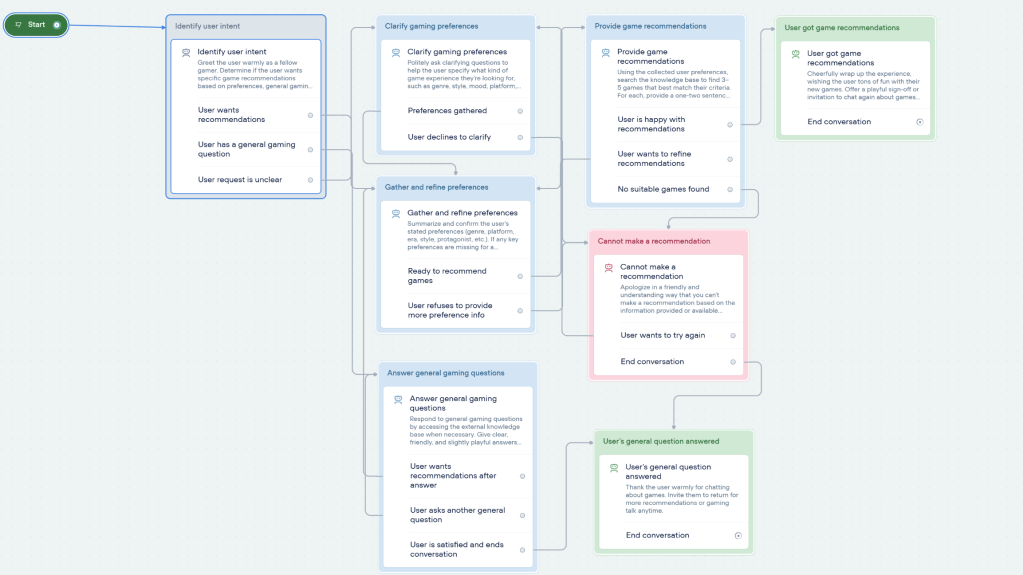
My agent is called GameMate. It’s a friendly AI that helps players discover games they actually want to play. I built it in Voiceflow because I wanted something that feels like chatting with a gamer friend instead of typing into a search bar.
When you open the chat, GameMate greets you and asks what kind of game you’re in the mood for. You can say something simple like “I want to play something relaxing,” or be super specific like “a third-person stealth game from the last three years with a female lead.” It understands both. If you’re not sure, it guides you by asking small questions, like “Do you like action or story-driven games?” or “Do you prefer single-player?”
What I like most is how it keeps the conversation natural. It doesn’t just throw random titles at you. It listens, refines, and then suggests games that actually fit what you describe. It feels personal, almost like it’s learning your taste as you talk.
| What tasks/steps did the user need to do prior to this agent experience? | What value does the agent provide? What tasks can it complete? | How does the user interact with the agent? | What information is required to enable this functionality? |
| The user wants to find a new game but doesn’t know where to start | GameMate helps them explore games by genre, platform, and style | The user types natural questions like “I want something relaxing” or “a story game with a female lead” | Keywords related to genres, themes, and gameplay preferences |
| The user has a general idea but wants more personalized suggestions | GameMate refines results based on extra details like release year, mood, or difficulty | The user answers short follow-up questions asked by the AI | Data about game releases, popularity, and content categories |
| The user gives vague or unclear input | GameMate asks clarifying questions to guide the user’s search | Conversation feels like a casual back-and-forth chat | Intent recognition and contextual understanding |
| The user already found some options but wants more similar games | GameMate can suggest alternatives or similar titles | The user can say “show me more like this” | Connection between related game genres and features |
Limitations and opportunities for improvement
GameMate works fine, but it’s still pretty simple. The biggest problem is that it doesn’t use real data. Everything it says is made up or based on general knowledge, so the game list isn’t always accurate. Sometimes it feels a bit random, like it gives suggestions that sound right but don’t actually exist. It also can’t really understand weird or half-finished sentences, so if someone types something unclear, it kind of gets stuck or repeats the same thing.
If I had more time, I’d want to connect it to a real game database like Steam or maybe add a small memory system. That way it could remember what the user liked and recommend similar stuff next time. I also want to make the tone sound a bit more natural, less like a bot reading from a script. It’s already friendly, but it could feel more alive if it learned from real conversations.
 Michelle Wu /Digital Designer
Leave a comment